[email protected]
+51 919046000
Climate tech (climate technology) brings together innovations that reduce emissions, save energy, and make homes and businesses more resilient. In this article, you’ll explore 9 solutions already being used in the real world, how they compare, and a simple method to decide which one fits your case (costs, impact, and feasibility). By the end, you’ll have a clear map to understand what is working today and which trends are accelerating the transition.
📌 Table of Contents
Climate tech refers to technologies that reduce emissions, increase energy efficiency, capture or avoid CO₂, and help us adapt to climate events. It’s not just “solar energy”: it includes software, materials, agriculture, mobility, power grids, cooling, climate finance, and more.
Why now? Because energy costs, regulatory pressure, supply chain requirements, and access to financing are rewarding projects with measurable impact. In practice, the key question is: which solution reduces the most CO₂ per dollar invested, and how easy is it to implement?
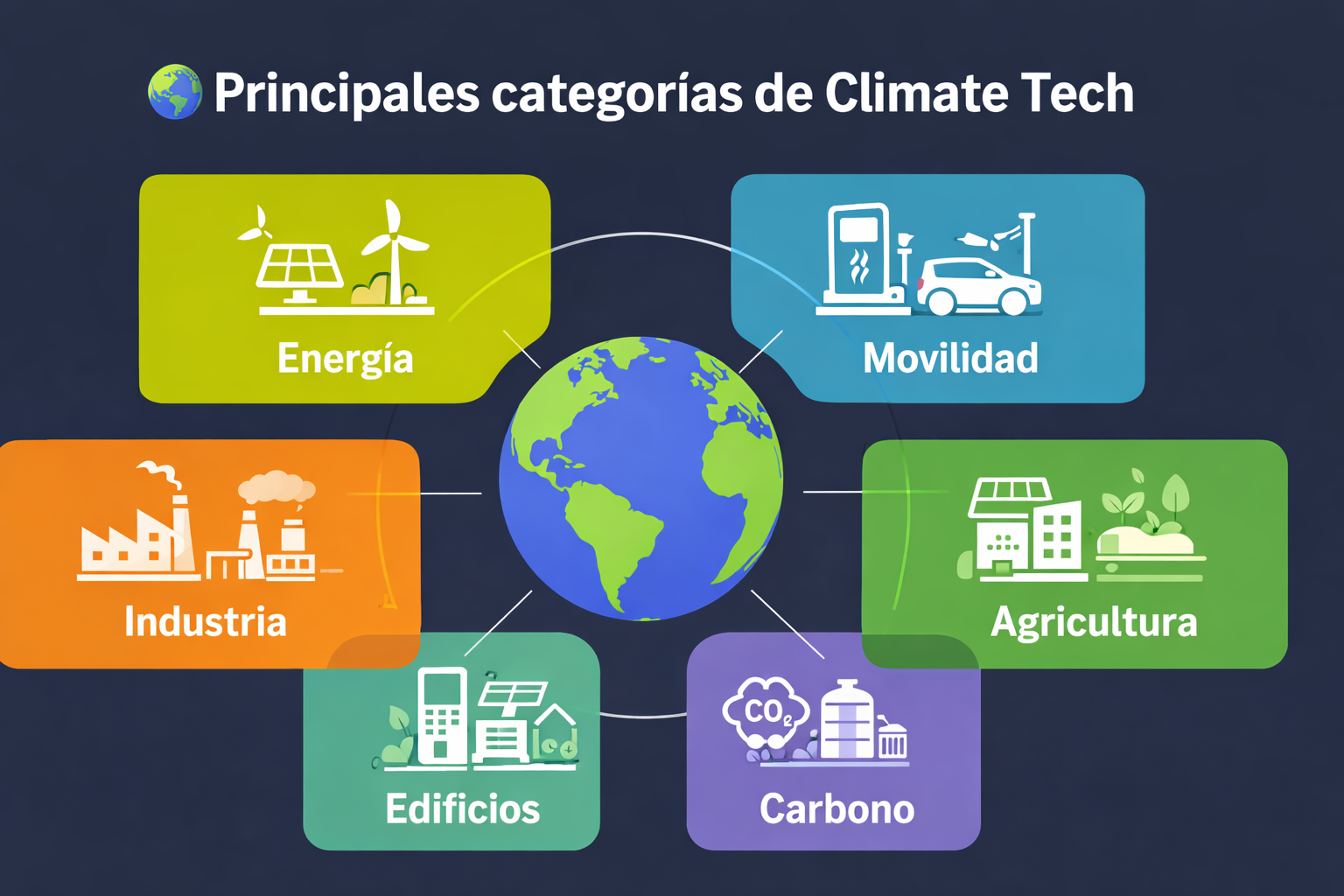
Combining solar panels with batteries enables self-consumption, backup during outages, and reduced usage during peak hours. Its appeal grows where there are variable tariffs or high energy costs.
In areas with strong wind resources, local generation reduces transmission losses and improves resilience. Microgrids integrate wind, solar, batteries, and smart management to operate even during main grid failures.
A significant share of carbon footprint comes from heat (boilers, furnaces, steam). Technologies such as industrial heat pumps, advanced electric resistance, or induction reduce emissions when electricity comes from clean sources.
Sensors, analytics, and AI detect abnormal consumption, optimizing HVAC, lighting, and processes. This is often one of the paths with the best ROI because it reduces costs from the first month without major construction.
Electrifying fleets (last mile, taxis, buses) lowers emissions and operating costs when charging is properly planned. The key is not only the vehicle but charging management to avoid peaks and take advantage of tariffs.
In many climates, improving insulation, sealing, and HVAC systems drastically reduces energy consumption. If your bill is high, this is often one of the quick wins.
Heavy industry emits significantly due to chemical processes and intensive heat. Alternative materials (or process improvements) reduce “embedded” CO₂ in construction and products. Measuring with LCA (life cycle assessment) is key.
Regenerative practices can improve soils, retain water, and reduce inputs, with climate benefits. Climate tech here is often about measurement: satellites, sensors, traceability platforms, and MRV (measurement, reporting, and verification).
Cooling is critical for food, healthcare, and comfort. Improving efficiency and switching to refrigerants with low global warming potential (GWP) can reduce both direct and indirect emissions.
🔗 Recommended Reading
To avoid “nice-looking” but ineffective projects, use this 3-step matrix. It works the same for homes, SMEs, or industry:
Practical tip: if you don’t know where to start, efficiency + software often wins (lower investment, fast results), followed by clean generation or electrification depending on your case.
In 2026, what accelerates is the combination of measurement + automation: platforms connecting sensors, bills, operations, and reporting for faster decisions. There is also growing focus on resilience (operational continuity) and reducing scope 3 emissions (suppliers and logistics), as many companies now require this across their supply chains.
Is climate tech the same as renewable energy?
No. Renewables are one part. Climate tech includes software, efficiency, materials, agriculture, mobility, grids, cooling, and solutions to measure and reduce emissions.
Which solution usually delivers the fastest results?
Energy efficiency (equipment optimization, behavioral changes, and smart controls) typically shows immediate savings and paves the way for electrification or clean generation.
How can I measure my CO₂ impact without being an expert?
Start with your consumption (kWh, liters, m³) and use emission factors published by energy authorities or inventory guidelines. The key is to stay consistent and improve accuracy over time.
What should a project include to attract investment or financing?
A clear economic case (savings/revenue), verifiable measurement (MRV), controlled risks (operations, permits, suppliers), and a scalability plan.
Climate tech is no longer “the future”: it is a set of solutions competing on impact, cost, and feasibility. If you start by measuring your consumption, prioritize efficiency, and define clear KPIs, you’ll be able to scale toward larger projects (electrification, storage, materials, or mobility) with better results.


 February 24, 2026 - POR Administrador